
Coding interviews · For candidates
A coding interview copilot for algorithms, debugging, and system design.
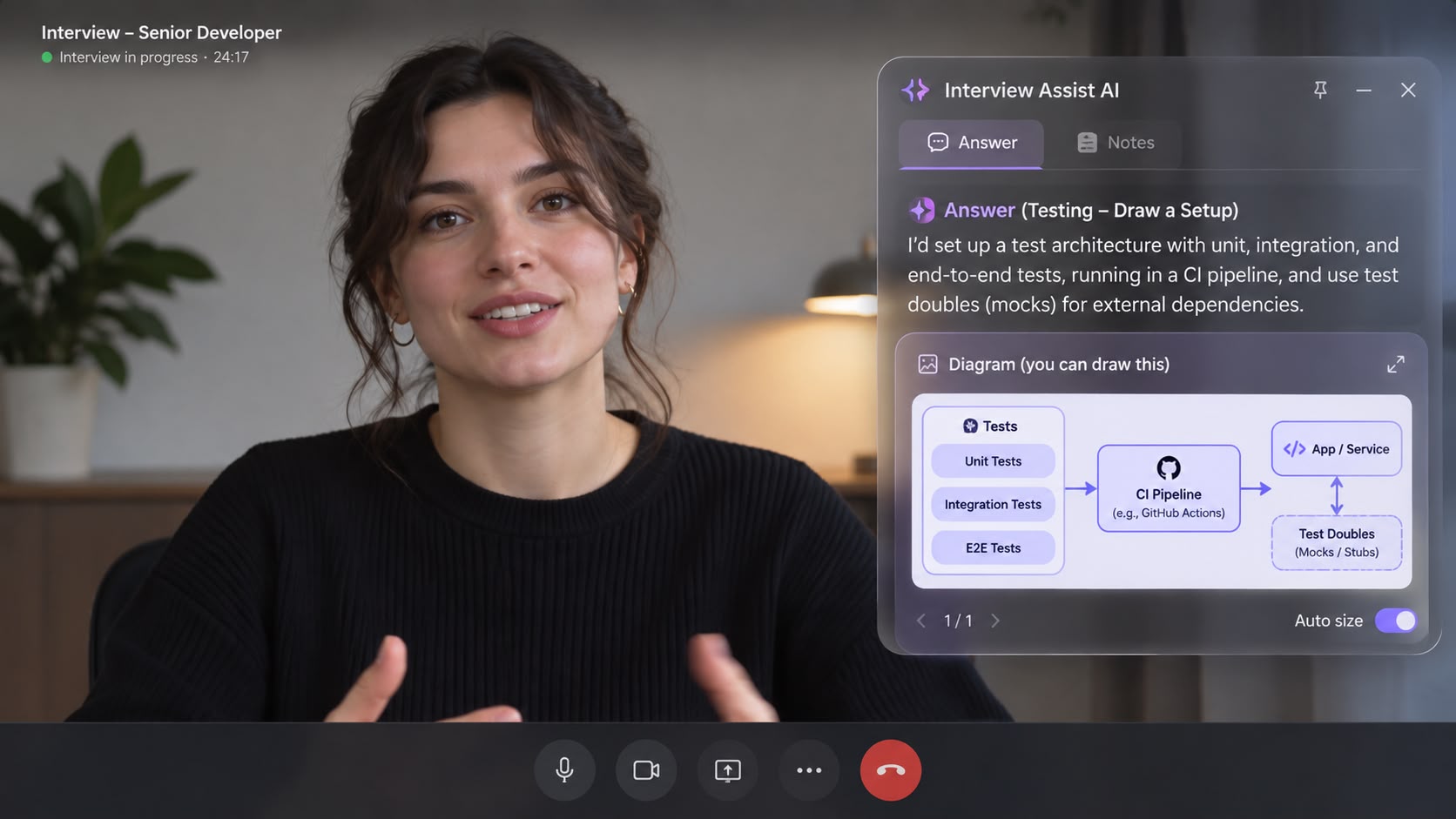
InterviewAssist hears the problem on the call, then lays out the approach, the complexity, edge cases, and working code in the language you choose, in short points so you can explain your thinking out loud.
- Free to start
- No credit card required
- Runs in your browser · Mac & Windows apps
Offers landed
Our users receive offers from the following companies

Hears the problem
When the interviewer reads out the problem, the copilot picks it up from the call. No copying or pasting.
Explain, then code
You get the approach and the trade-offs first, so you can talk through it before typing.
System design included
Requirements, capacity estimates, components, data model, and bottlenecks, in the order interviewers expect.
Capabilities
What coding interviews does
Every capability below is included on every plan and works with the same CV, job post, and stories you already added.
01
Approach before code
Brute force, the optimal idea, and why it works, written as short points you can say out loud.
Approach before code
Bullet pointsBrute force
Compare every pair until nothing changes
Optimal
Sort, then one linear sweep
02
Complexity and edge cases
Time and space complexity plus the empty input, duplicates, overflow, and off-by-one cases worth mentioning.
Complexity and edge cases
Say it out loudComplexity
O(n log n) time, O(n) space
Mention
Touching intervals count as overlapping?
03
Code in your language
Python, Java, JavaScript, TypeScript, C++, C#, Go, Rust, Kotlin, Swift, Ruby, and SQL.
Code in your language
PythonLine 1
intervals.sort(key=lambda x: x[0])
Then
Extend the last range or start a new one
Also included
Debugging help
Talk through a failing test or an error out loud and get the likely cause and a minimal fix.
System design framework
Clarifying questions, API, data model, high-level design, scaling, and failure modes, adapted to the prompt.
Follow-up prediction
The likely next question, such as how to handle a stream or reduce memory, prepared before it is asked.
Practice problems by company
Mock coding rounds drawn from the patterns common at the company and level you are targeting.
How it works
How to use coding interviews
- 1
Set your language
Pick the programming language and the level of detail you want before the round.
- 2
Let it hear the problem
Share the call's tab audio. When the problem is read out, the approach starts to appear.
- 3
Talk through the approach
Read the approach and complexity first and explain it while you write.
- 4
Handle the follow-ups
Optimizations and edge cases are ready when the interviewer pushes further.
Built for the moments that matter
- LeetCode-style rounds
- Live pair programming
- Take-home walkthroughs
- System design interviews
- Data and SQL rounds
- Debugging exercises
Coding interviews: InterviewAssist compared
How it stacks up against the tools people usually try first.
| Capability | InterviewAssist | General AI chatbot | Practice-only prep app |
|---|---|---|---|
| Hears the problem on the call | |||
| Approach and complexity in points you can say out loud | If prompted | Sometimes | |
| System design framework | Generic | Sometimes |
FAQ
Coding interviews questions
Still have a question? Contact us
Does InterviewAssist help with LeetCode-style coding interviews?
Yes. It hears the problem on the call, then gives the approach, complexity, edge cases, and working code in your chosen language, in short points you can say out loud. Scan screen can also read the problem straight from your screen.
Which coding platforms does it work with?
Any of them, because it listens to the call rather than the editor: CoderPad, HackerRank, CodeSignal, LeetCode, Codility, CodeInterview, shared Google Docs, and whiteboards like Excalidraw and Miro.
Which programming languages are supported?
Python, Java, JavaScript, TypeScript, C++, C#, Go, Rust, Kotlin, Swift, Ruby, PHP, Scala, and SQL.
Can it help with system design interviews?
Yes. It structures an answer around clarifying requirements, capacity estimates, APIs, the data model, high-level components, scaling, and failure modes, and prepares likely follow-ups.
Does it read my screen?
No. It works from the call audio you share, so problems need to be said out loud. If you share your whole screen, the InterviewAssist tab is visible like any other window, so share a single tab or window instead.
Related features
Candidates
System design interviews
Clarifying questions, a step-by-step design and an architecture diagram during a live system design interview, from the call or your screen.
Read moreCandidates
Live Copilot
Get a strong answer to every interview question in real time, plus live coaching tips as you go. Works with Zoom, Meet, Teams and phone calls.
Read moreEveryone
Web app
Runs in Chrome or Edge with nothing to install. Share your call's tab or use your mic and get real-time interview answers. Also on Mac and Windows.
Read moreCandidates
Mock interviews
Practice with an AI interviewer built for the job you want. Speak your answers, get scored on each one and see exactly what to fix.
Read moreWalk into your next interview prepared.
Add your CV and the job post, run a mock interview, and keep the live copilot beside the call. Setup takes about five minutes.
Free to start · No credit card required